Research
The primary research theme of the NCCR was to use inspiration from nature to design artificial materials that can change their properties “on command” - in other words, in response to an external stimulus. These materials, sometimes called “smart” or “intelligent”, are of fundamental scientific interest and potentially valuable for countless applications ranging from building climate control to drug delivery systems.
In Phase 1 (2014-2018) and Phase 2 (2018-2022), the NCCR scientists opened new research areas and new research opportunities in existing areas, including nature-inspired polymer recycling, high-throughput emulsification, new displacement-type mechanophores and organoids on-a-chip with the potential to enable the generation of physiologically relevant human tissues and organs. In Phase 3 (2022-2026), the center continued carrying out paradigm-changing research, increasing the number of collaborations across disciplines, focusing on the translation of bio-inspired materials research and consolidating the structure of the Center that would carry the legacy of the NCCR beyond the end of Phase 3.
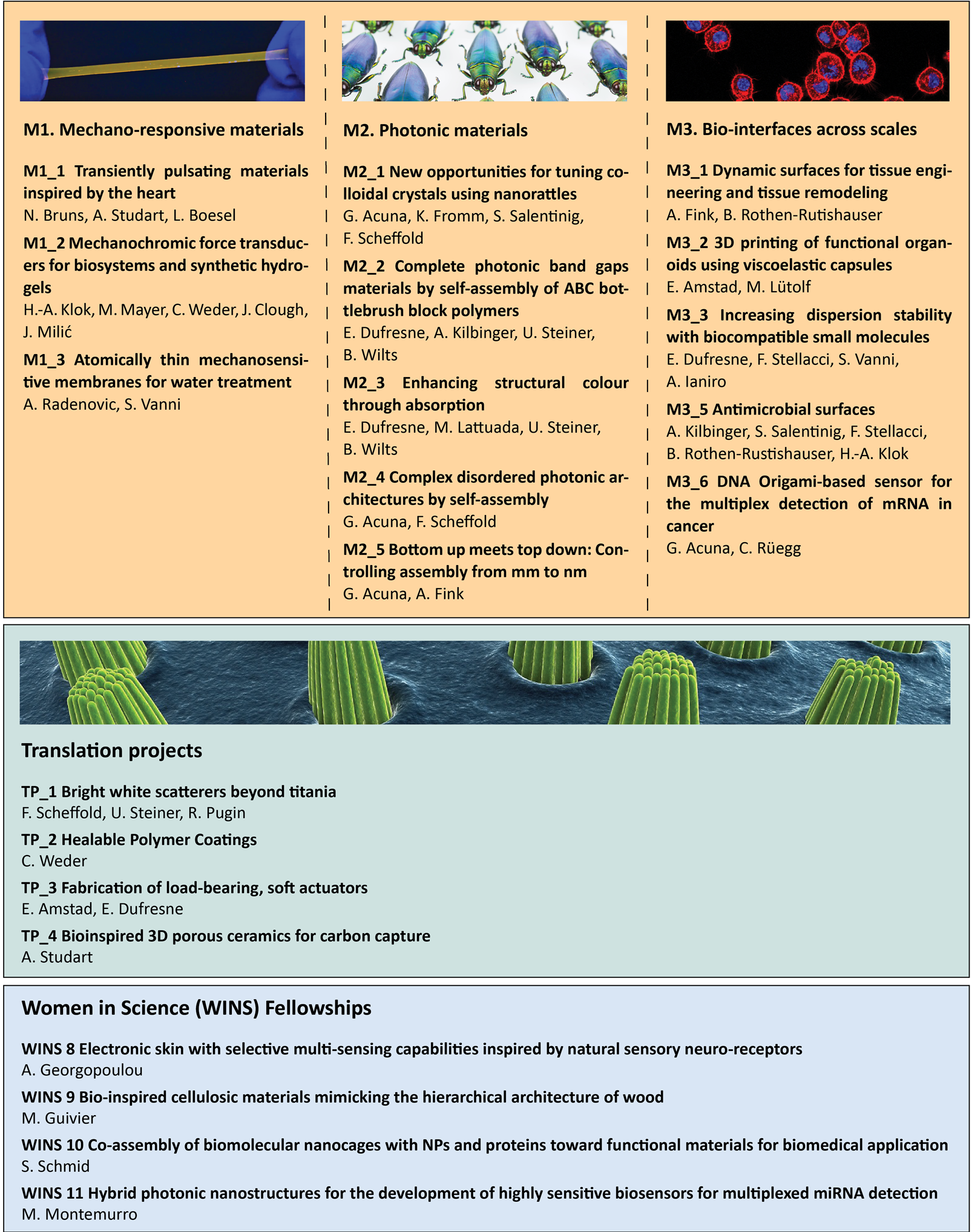
Throughout the three funding phases, the NCCR’s research program was organized into three topical modules focusing on mechano-responsive materials, photonic materials, and bio-interfaces across scales. Two additional research modules were active in Phase 2 (Dynamics of interacting cell-material systems) and Phase 3 (Translation-oriented projects).
If you want to read more about it, you can consult our research stories here.




Research Program NCCR Bio-inspired Materials