Special issuePublikationsdatum 18.05.2026
Showcasing 12 years of bio-inspired research
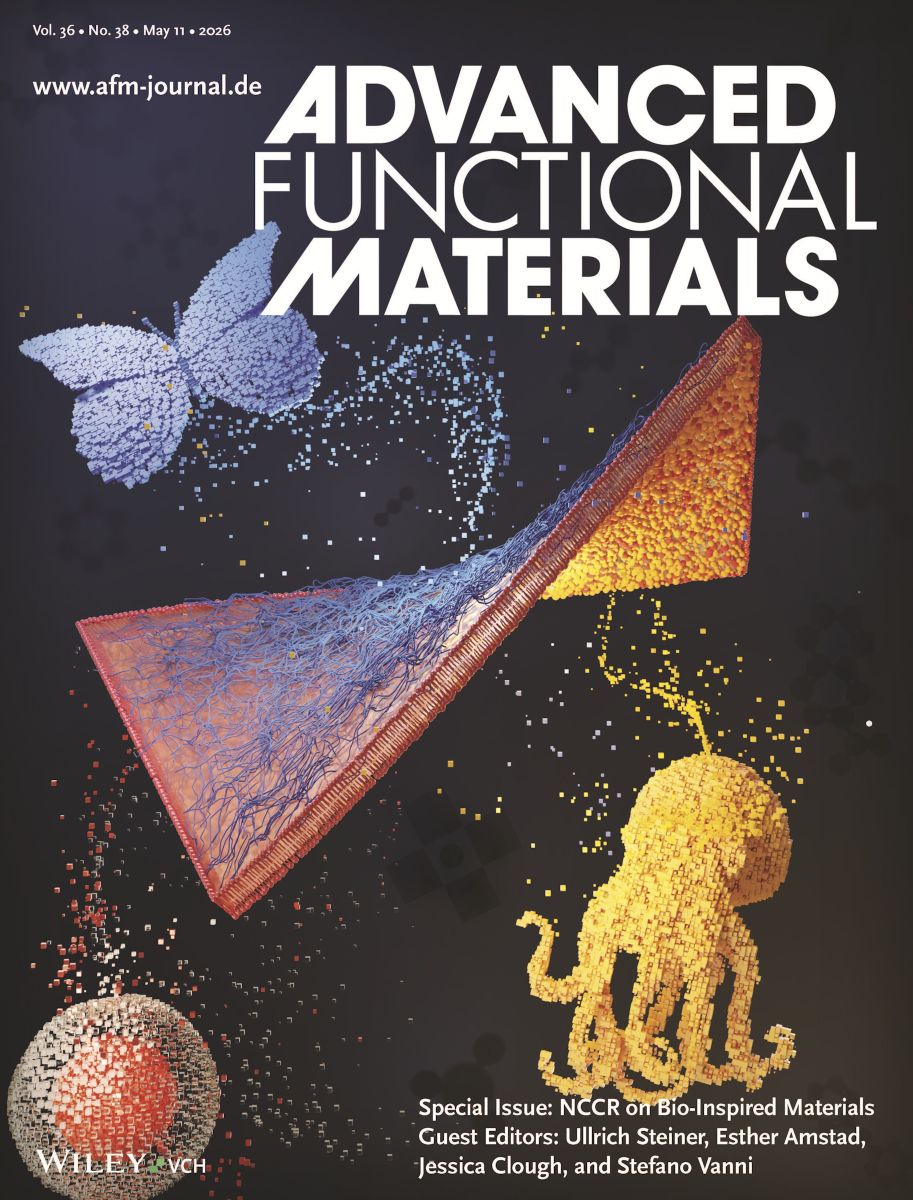
The NCCR Bio-Inspired Materials has capped its 12‑year mission with a special issue of the journal Advanced Functional Materials, highlighting how nature‑inspired design can transform future technologies.
Led from the Adolphe Merkle Institute at the University of Fribourg, with EPFL and ETH Zurich as core partners, the research network has brought together 30 groups from Switzerland, Europe, and the USA to develop materials that can adapt, respond, and interact with living systems.
Founded in 2014 with funding from the Swiss National Science Foundation and support from its Home Institution, the University of Fribourg, the NCCR has focused on three main themes: mechanically responsive materials, photonic materials, and bio‑interfaces. This work has led to new families of tough, stimuli‑responsive polymers and hydrogels, advanced optical materials inspired by natural colors, and bio‑interfaces that underpin broad‑spectrum antivirals, targeted cancer therapies, and organoid‑based tissue models. Other cross‑disciplinary projects have tackled challenges such as bio‑inspired power conversion, “lab‑on‑a‑chip” platforms for studying cell–material interactions, and more sustainable plastics.
The Advanced Functional Materials special issue gathers contributions from current and former NCCR members and their collaborators. Among the highlights are: new hydrogels and polymers that adapt to mechanical stress; butterfly‑ and cephalopod‑inspired photonic structures for color and security printing; DNA‑origami‑based optical devices and nanoantennas for single‑protein detection; pathogen‑responsive hydrogels that combine bacteriophages and probiotics; and injectable, enzyme‑loaded pastes that mineralize into load‑bearing bone scaffolds within days. The issue also presents 3D‑printed hydrogels inoculated with mycelium, establishing fungal‑based “living materials” that act as both bio‑factories and structural scaffolds.
Beyond research, the NCCR has placed strong emphasis on training and career development. The Women in Science Fellowships have, for example, supported eleven independent projects led by female researchers, six of whom have since moved into assistant professorships or equivalent roles worldwide. The Undergraduate Research Internship (URI) program has brought more than 180 students from 63 universities into NCCR laboratories, leading to 21 co‑authored scientific publications and a growing international alumni network.
The NCCR Bio‑Inspired Materials will mark the close of its funding period with an international conference on bio‑inspired materials at the University of Fribourg on June 19 and 20, 2026. While the Center’s mandate is ending, the concepts it helped establish – from self‑adjusting polymers and bio‑inspired optics to living scaffolds and recyclable plastics – will continue to shape new approaches in chemistry, physics, materials science, and biomedicine.
The special issue can be read here: https://advanced.onlinelibrary.wiley.com/toc/16163028/2026/36/38